Skip to content
Red Rocks Credit UnionJun 18, 20266 min read

Why It Pays to Start Saving Sooner Than You Think

 
Saving for Your Future

Understanding Compound Interest: What Savers Should Know

Compound interest is one of those concepts that sounds complicated but clicks fast once you see it in action. We put everything you need to know in one place, from the basics to the real numbers to exactly what to do next.

Untitled (750 x 1250 px) (750 x 750 px)


What Is Compound Interest?

At its core, compound interest means you earn returns on your returns. Here's a simple way to picture it.

Imagine a snowball rolling down a hill. At the top, it's small. But as it rolls, it picks up more snow, making it bigger, so it picks up even more snow. The longer it rolls, the faster it grows. By the bottom of the hill, it's a completely different size than when it started. Your savings work the same way.

With simple interest, you only ever earn on your original deposit. With compound interest, your earnings get added back in and start earning too. Then those earnings earn. It builds on itself, over and over, every year.

The math behind it looks like:

A = P(1 + r/n)^nt

A is the future value 
P is the principal
r is the annual nominal interest rate
n represents compounding intervals per single year
t represents the total number of years

Don't let the formula intimidate you! What it's really saying is that time is the most important ingredient. A small amount of money, given enough years, can grow into something much larger than you'd expect.


The Numbers That Shock People

Nothing makes compound interest click quite like seeing it in concrete numbers. So let's look at two people, Alex and Jordan, who make almost identical financial decisions (keyword: almost).
Both Alex and Jordan:

— Are the same age
— Invest $300 a month

— Earn an average 7% annual return
— Keep going until age 65

image-2

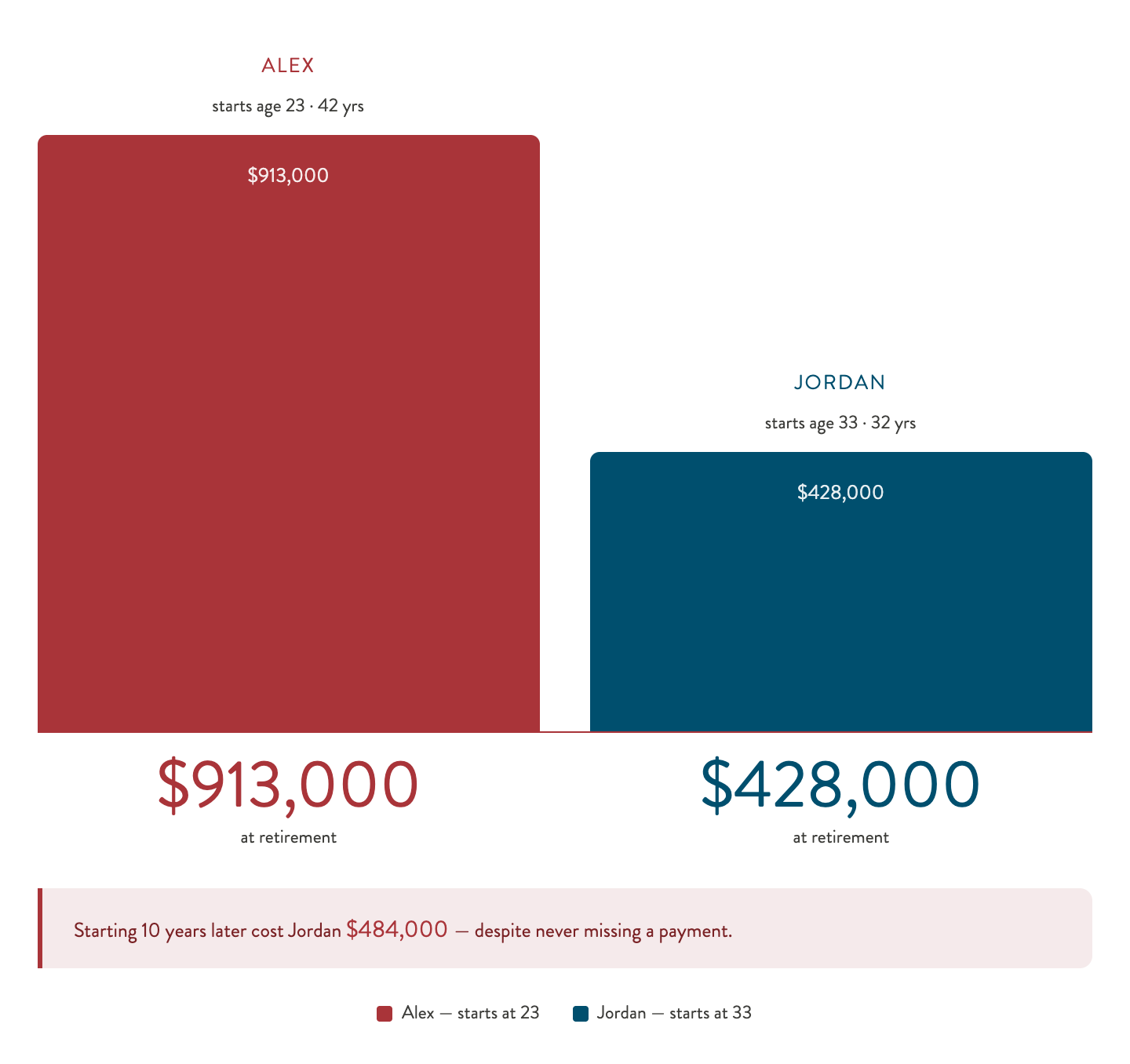
The only difference is when they start: Alex starts at 23, Jordan waits until 33.

By retirement, Alex has grown their savings to over $913,000. Jordan, despite investing for 32 years and never missing a payment, finishes with around $428,000.

Nearly half a million ($484,000), just from starting earlier.

The most encouraging part of that story? Neither of them did anything extraordinary. No risky investments or financial expertise required. They showed up consistently and let compounding do the rest. The only thing that separated their outcomes was the decision to start.

That's great news, because it means the most powerful thing you can do for your financial future doesn't require a big salary or perfect budget. It just requires starting. Even small contributions, made consistently and given time to grow, can add up to something life-changing.

Wherever you are right now, starting today puts you ahead of where you'd be tomorrow.


Three Things You Can Do:  Here's What Moves the Needle When It Comes to Compound Interest.

AdobeStock_300202528-1


  • 01 Start Early
  • 02 Automate
  • 03 Let It Grow

Start before you're ready

There's never going to be a perfect time. Life will always have something competing for your money: a bill, a move, a big purchase on the horizon. Waiting until things seem more stable is one of the most common reasons people look back and wish they'd started sooner. Starting small still counts. Even a modest amount saved now is worth more than a larger amount saved five years from now. Done beats perfect every time.

Automate it so it's effortless

The easiest way to save consistently is to make it something you never have to think about. Set up an automatic transfer on payday (even a small one!) so the money moves before you have a chance to spend it elsewhere. Most people find that after a month or two, they don't miss it at all. Automation removes willpower from the equation entirely, and that's what makes it so effective.

Leave it alone when life gets bumpy

Markets fluctuate, and life throws curveballs. When things feel uncertain, the instinct can be to pull back or cash out, but that's usually the most costly move you can make. Compounding works best when it's uninterrupted. Trust the process, even when it's uncomfortable.


RRCU Email + Blog Cover Images-Jun-05-2026-02-35-49-7959-PM

Start Small with Red Rocks Credit Union

Now that you know how compounding works, where do you put the money?


A Reverse Tier Savings Is A Great Starting Place

Most savings accounts reward members who already have large balances. Reverse Tier Savings flips that entirely.

You earn more on your first $2,000, so your earliest dollars work the hardest for you. There’s no minimum deposit required to open the account and no service fees.

For someone younger who wants to let compounding work without needing a big chunk of money to make it worthwhile, it doesn't get much easier than this. Put in what you can, earn a strong rate from the start, and add more as life allows.

Ready to take the first step?


FAQs: Compound Interest Explained

What is compound interest? Compound interest is when you earn interest not just on the money you put in, but also on the interest you've earned. Over time, that adds up to significantly more growth than simple interest, especially the longer you leave it.
How is compound interest different from simple interest? Simple interest only grows based on your original deposit. Compound interest grows based on your deposit plus everything it's already earned. The difference can seem small early on, but over years or decades, it becomes dramatic.
Why does starting early matter so much with compound interest?

The longer your money compounds, the more it accelerates. The growth in year 30 is far larger than the growth in year 10, so every year you wait costs you some of your biggest returns.

How much do I need to start saving to benefit from compound interest?

Less than most people think. Even small, consistent contributions can grow significantly over time thanks to compounding. The amount matters less than starting and starting early.

Does compound interest work in a regular savings account?

Yes. Most savings accounts compound interest, though the rate varies. The higher the rate and longer your timeline, the more compounding works in your favor. That's why choosing the right savings product matters.

What’s the best way to take advantage of compound interest?

Start as early as you can, contribute consistently, and resist the urge to pull the money out. Automating your savings so it happens without thinking about it is one of the best ways to let compounding do its job.