

Small Budget, Big City
From Campus to Credit Union: A Denver College Student’s Guide to Saving
The Denver-metro area is an incredible place to go to school, but not the cheapest. Saving can feel like something to figure out later, but starting early makes a big difference. This guide walks through everything you need to know to get started, whether you grew up here or just moved to Denver for school.

The Reality of Saving Money in College
Saving money in college isn't always easy. Between tuition, rent, and the general cost of living your life, most students aren't working with a lot of wiggle room. Then in Denver, where the cost of living has climbed steadily over the past few years, that reality hits harder than it might in other college towns.
Rent alone can take up a huge chunk of a student budget. Whether you're living near the University of Denver, commuting to CU Denver or Metropolitan State University, or sharing an apartment close to Regis or Community College of Denver, housing costs add up fast. Add groceries, an RTD pass or gas money, textbooks, and the occasional dinner out, and it's easy to see why saving feels like an afterthought.
Here's what's worth remembering: saving in college was never about putting away hundreds of dollars a month. It's about building the habit and starting with whatever you have.
Even $20 a month goes somewhere. A small, consistent contribution to a dedicated savings account adds up faster than you'd expect. More importantly, it creates a pattern that sticks long after graduation. The students who come out of college in the strongest financial position aren't necessarily the ones who earned the most. They're the ones who started saving early, kept it simple, and didn't wait until things felt more stable to begin.
The Denver-metro area is an incredible place to build your life in. Starting your savings habit here (even on a tight budget!) is one of the best financial decisions you can make while you're a student.
What to Look for in a Savings Account as a College Student
Not all savings accounts are created equal, and some aren’t designed with students in mind. Before you open one, look at what matters when you're working with a smaller budget.
A competitive APY
APY stands for Annual Percentage Yield. It's the rate your money earns over a year, factoring in compounding. The higher the APY, the more your savings grow without any extra effort. Even a difference of a percentage point or two adds up over time. For a deeper breakdown of how APY works, check out our APR vs. APY vs. Dividend Rate guide.
No monthly fees
This one is non-negotiable on a student budget. A monthly service fee might seem small, but it eats into your savings over time. Always look for an account with no monthly fees.
No minimum balance requirements
A lot of traditional savings accounts require you to keep a minimum balance to avoid fees or qualify for a good rate. For students starting with a small amount, that can be a barrier. Look for an account that lets you earn a solid rate no matter how much you have in it.
Easy digital access
You should be able to check your balance, make transfers, set up automatic deposits, and manage your account entirely from your phone. If the digital experience is clunky or outdated, keep looking.
The best savings account for a college student is one that meets you where you are financially, not where a bank wishes you were.
What Is a Reverse Tier Savings Account?
If you've never heard of a reverse tier savings account before, you're not alone. But for college students and anyone just starting to build savings, it’s one of the most useful options.
The idea: most traditional savings accounts are structured to reward people who already have a lot of money saved. The bigger your balance, the higher your rate. Which is great if you've got a large sum sitting around, but not so helpful if you're getting started.
A reverse tier savings account flips that model entirely.
Instead of saving your best rate for your largest balance, a reverse tier savings account gives you the highest rate on your first dollars. Smaller balances earn more, not less.
For a college student putting away $50 or $100 a month, that difference matters. You earn a competitive rate from the start, without needing to meet a minimum balance threshold or wait until your savings reach a certain level.
Here's how it compares to a traditional savings account:
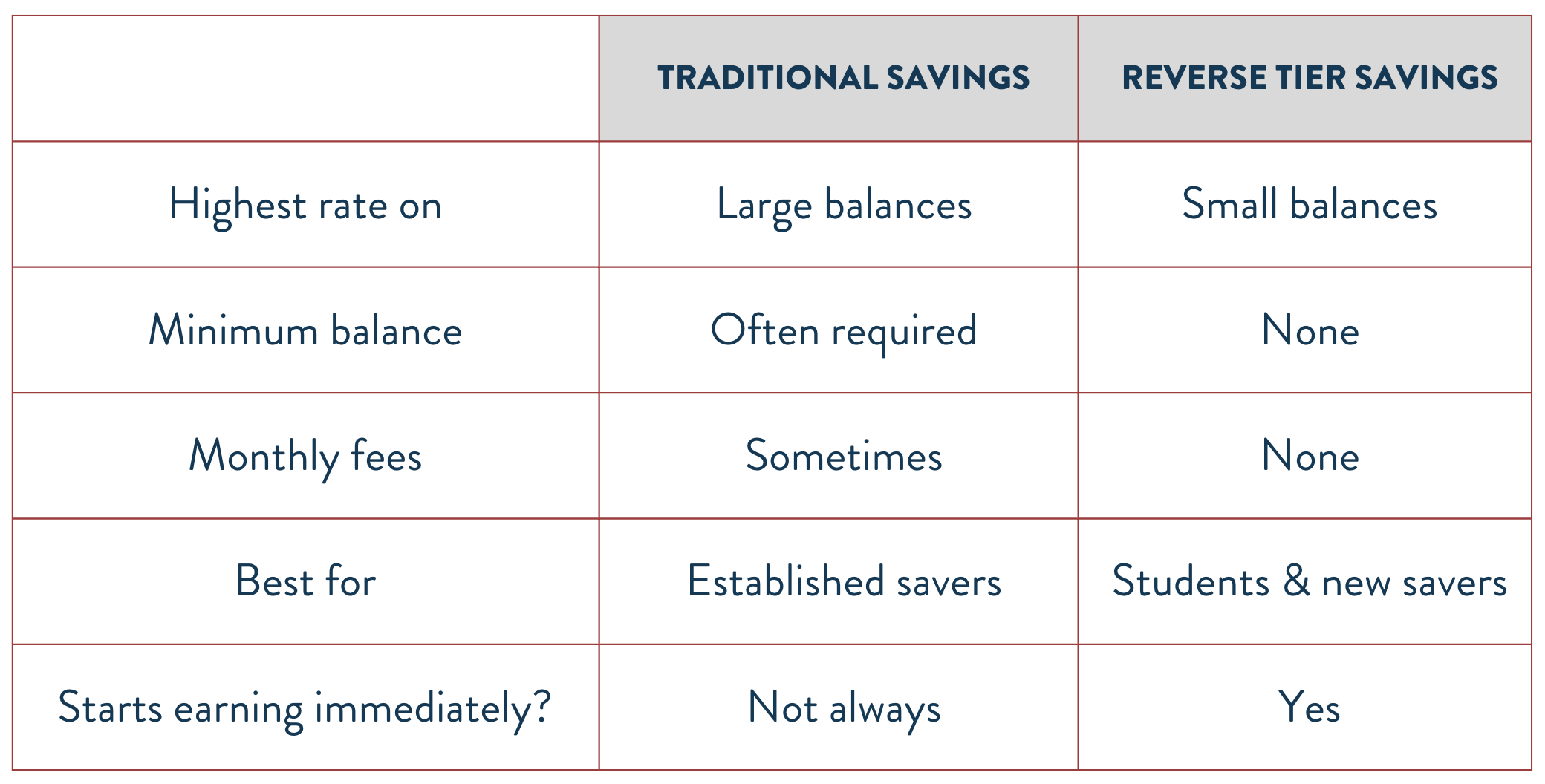
The bottom line: traditional savings accounts are for people who have money saved up. Reverse tier savings is for people who are in the process of building it.
How to Save Money in College On a Tight Budget
Saving money in college doesn't have to mean cutting out everything fun or living on ramen five nights a week. It's really about a handful of small habits that add up over time without making your day-to-day life feel miserable.
Automate it so you don't have to think about it
This is one of the most effective savings habits, and it works especially well on a student budget. Set up an automatic transfer to your savings account on payday, even if it's just $10 or $20. If the money moves before you see it, you won't miss it. Set it once and let it run in the background.
Save a percentage, not a fixed amount
Committing to a specific dollar amount every month can be stressful when your income varies. Instead, try saving a percentage, even 5 or 10% of whatever comes in. A slower month means a smaller transfer, and that's okay. The habit stays consistent even when the amount doesn't.
Keep your savings separate from your spending
If your savings and spending money live in the same account, you'll spend the savings. It's just how it works. Keeping them in a separate account, even at the same institution, creates a barrier that makes you think twice before dipping into it.
Take advantage of Denver's student discounts
Denver has a lot to offer, and a lot of it comes with a student discount if you know where to look. The RTD CollegePass gives eligible students unlimited rides for a fraction of the regular cost. Local museums, restaurants, and entertainment venues often have student pricing too. A quick search before you pay full price is always worth it.
Cook more, eat out less
Food is one of the biggest budget drains for college students, and one of the easiest places to find savings. You don't have to meal prep every Sunday like a lifestyle blogger, but cooking a few more meals at home each week makes a dent in monthly spending. Denver has great grocery options at a range of price points, and your future self will thank you.
Use your campus resources
Most Denver-area colleges offer free or reduced-cost resources that students don't take full advantage of, from food pantries and free mental health services to software, printing, and fitness facilities. CU Denver, Metropolitan State University, University of Denver, Regis, and Community College of Denver all have resources worth exploring. Using what's available frees up money for everything else.
You don't need a perfect budget or a big paycheck to save money in college. You just need a few habits that run in the background, and an account that works with what you have.
Build an Emergency Fund
Nobody plans for their car to break down the week before finals or for a laptop to die right in the middle of a semester. Unfortunately, these things happen, and when they do, having a small financial cushion can be the difference between a stressful situation and a destabilizing one.
That's what an emergency fund is for. It's not a vacation fund or a "treat yourself" account, but a dedicated buffer for the moments life throws something unexpected at you.
How much should a college student have in an emergency fund?
The traditional recommendation is three to six months of expenses, but for most college students, that number seems out of reach, and that's okay. A more realistic starting goal is $500 to $1,000. That covers most common emergencies without requiring you to have it all figured out from the start.
How to build one gradually
The key word is gradually. You don't need to fund it all at once. Instead, start directing a small amount toward it consistently. Even $10 or $15 a week adds up to several hundred dollars over the course of a semester. Set up an automatic transfer, label the account something that reminds you what it's for, and let it grow in the background.
Keep it separate
An emergency fund only works if you don't accidentally spend it. Keep it in a separate savings account from your everyday money. You want it somewhere accessible enough to reach when you need it, but not so visible that it becomes tempting on a regular Tuesday.
Banking in Denver: What Out-of-State Students Should Know
If you moved to Denver for school, figuring out your banking situation probably wasn't at the top of your to-do list. However, once you're settled in and living your day-to-day life here, having a local account starts to make a lot more sense.
You don't have to close your old account
This is the most common misconception. Moving to a new state doesn't mean you have to overhaul your entire financial life on day one. Plenty of students keep their existing account for things like receiving money from family or managing accounts they've had for years, and open a local account for everyday spending and saving in Denver. Having both is a completely reasonable approach.
Why a local account is worth having
When your credit union is local, everything works a little more smoothly. In-person support is nearby if you need it, depositing cash is easy, and you're banking with an institution that understands the community you're living in. For students putting down roots in Denver (even temporarily), that convenience adds up.
Why a credit union might be the right fit
Credit unions like Red Rocks Credit Union are member-owned, so they're not trying to maximize profit for outside shareholders. That translates to fewer fees, better rates, and a more personal experience than you'd get at a large national bank. For a college student who doesn't have a lot of extra money to absorb unnecessary fees, that difference matters.
-Sep-14-2026-03-18-19-5573-PM.png?width=300&name=RRCU%20Email%20+%20Blog%20Cover%20Images%20(1)-Sep-14-2026-03-18-19-5573-PM.png)
Where to Start in Denver
Red Rocks Credit Union is a Colorado-based credit union with membership open to students in the Denver area.
Our Reverse Tier Savings account was built for most college students: just getting started, working with a smaller balance, and looking for an account that rewards that.
Open it, set up an automatic transfer, and let it do its thing while you focus on everything else college has going on.
Then, if you have questions along the way, we're easy to reach. Stop by any of our branches or give us a call. We're happy to help you figure out the right fit, no financial jargon required!